Difference Between New and Delete Operator in C++
If it makes sense to use smart-pointers then use them and dont bother to call delete but youll still need to call new. The new operator requests for the memory allocation in heap.
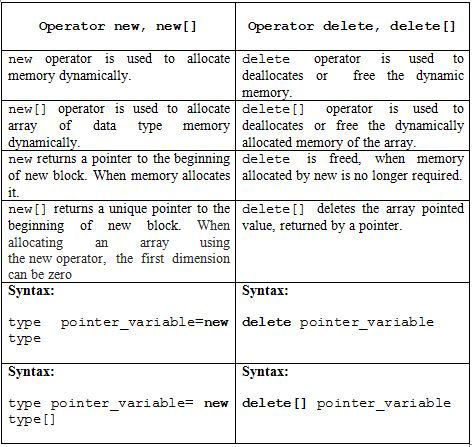
Chapter 11 Solutions C How To Program 8th Edition Chegg Com
If the sufficient memory is available it initializes the memory to the pointer variable and returns its address.

. It is either used to delete the array or non-array objects which are allocated by using the new keyword. The matching delete will be in the smart-pointer. The operator new is a function.
The delete operator free memory previously allocated using new. If it makes sense to use vector rather than new then use it. Using delete on a pointer to an object not allocated with new gives unpredictable results.
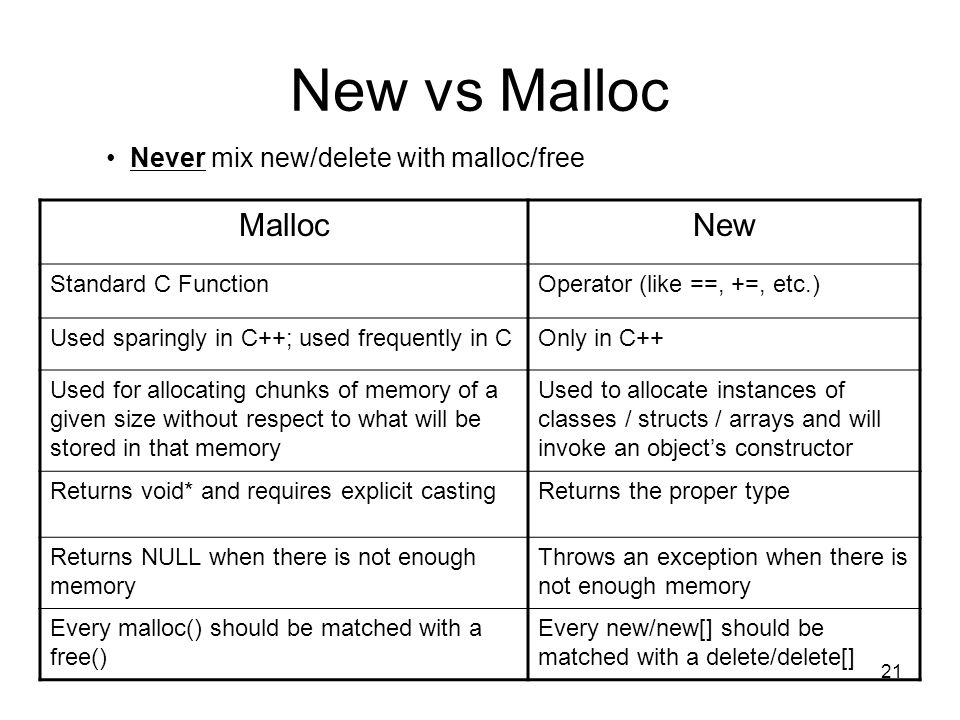
The functionality of the new or malloc and delete or free seems to be the same but they differ in various ways. It is present in C Java and C. Delete free the allocated memory and calls destructor.
An expression that uses new syntax for non-array type will implicitly call operator new function while an expression with new will implicitly call operator new. Moreover new operator helps to allocate memory for an array or an object whereas delete operator helps to. If you allocate with new you use delete If you construct with placement-new you call the destructor direct.
The new keyword allocated the memory in a heap. Lets learn the differences between free and delete. This provision means that when new returns 0 on failure deleting the result of a failed new operation is harmless.
Object_ptr is still usable here but it is pointing at an destroyed object so dont use it. The delete operator deallocates memory and calls the destructor for a single object created with new. The new operator calls the special function operator new and the delete operator calls the special function operator delete.
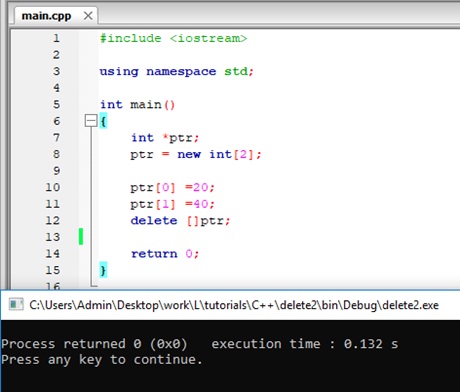
Dynamically allocated memory is allocated on Heap and non-static and local variables get memory allocated on Stack Refer Memory Layout C Programs for details. Here is an example of delete operator. It frees memory held by an array of an object which allocated using new.
You can however use delete on a pointer with the value 0. Delete delete It is used to release the memory occupied by an object which is no longer needed. In brief new is an operator in C that allocates memory for an object or an array of objects.
This operator is used to dynamically de-allocate the memory. This is conceptually similar to the malloc or calloc functions. It can defined as an operator which is used to release the memory allocated by new keyword such as objects and arrays.
If you used operator new you must use operator delete without the square brackets. On failure malloc returns NULL where as new throws bad_alloc exception. Delete is faster than free because an operator is always faster than a function.
The new function in the C Standard Library supports the behavior specified in the C standard which is to throw a stdbad_alloc exception if the memory allocation fails. In C when delete is used with an object it first calls the destructor of that particular object and then after deallocates the memory occupied by it. C tells us to use delete when reclaiming the memory space of a single object allocated with new and delete when reclaiming the memory.
Here are the examples of Examples of delete and free in C. It is an operator that can be. The important detail here is that an array created by new expression will.
You have to use delete if you allocated memory on the heap with operator new eg a dynamic array. Its a code generation artefact that happens because 1 user-defined operator delete must be able to handle NULL values and 2 compiler tries to generate the most optimal code possible. The delete operator deallocates memory and calls destructors for an array of objects created with new.
It is a C library function that can also be used in C while the new operator is specific for C only. It does not destroy the pointer but the value or. It is used to get rid of an arrays pointer and release the memory occupied by the array.
Difference between delete and free in C with simple example. In case of new memory is allocated from free store where as in malloc. Destructor of MyObject is called and memory freed.
To delete the array or non-array object we use delete and delete operator respectively. For basic data types there is no destructor so there is no difference between using delete and delete. Using delete on a pointer returned by new or delete on a pointer returned by new results in undefined behavior.
Delete and new operator. Constructor is called and memory allocated on the heap. Difference Between new and delete Operator in C Definition.
The general form is. But free de-allocate memory but does not call destructor. Here is the syntax of delete operator in C language delete pointer_variable.
In this post we will understand the difference between new and malloc. The pointer_ptr object object_ptr-doWork. This operator is used for pointers that are pointing to memory locations allocated using new or if this is a NULL pointer.
New returns exact data type while malloc returns void. Int main MyObject object_ptr new MyObject. This function does not call the constructor so memory is not initialized.
It is not related to deleting a built-in type or a custom class. Therefore we can say that the delete operator always de-allocates the memory from the heap. The difference between the signatures of non-destroying and destroying operator delete is that the former receives a void and the latter receives a pointer to the type of the object being deleted and a dummy stddestroying_delete_t parameter.
New is an operator while malloc is a function. Var is a pointer variable delete var. Using this we can allocate raw memory block.
The behavior with respect to constructors and destructors calls differ in the following ways. This function is used to overload the new operator. Delete is an operator whereas free is a library function.
However after returning the pointer from this overloaded method the. Dynamic memory allocation in CC refers to performing memory allocation manually by programmer. The delete operator is used to deallocate the memory.
If you allocate with new you use delete. It releases memory held by a single object which is allocated using new operator. User has privilege to deallocate the created pointer variable by this delete operator.
Here is the syntax to delete the block of allocated memory delete pointer_variable. Free and malloc. Operator new Out of Memory operator delete First of all this can really be simplified down to delete Widget0 - everything else in your main is unnecessary to repro this.
If we use delete it calls the. The delete operator is used to deallocate the memory. What is delete operator.
The malloc function returns a. User has the privilege to deallocate the created pointer variable by this delete operator. The new operator allocates memory and returns a pointer.
New and delete operators in C for dynamic memory. The delete operator is mostly used in C.

What Is The Difference Between New And Delete Operator In C Pediaa Com

What Is The Difference Between New And Delete Operator In C Pediaa Com

Overloading Operator New And Delete 1 Modernescpp Com

New And Delete Operator In C Scaler Topics
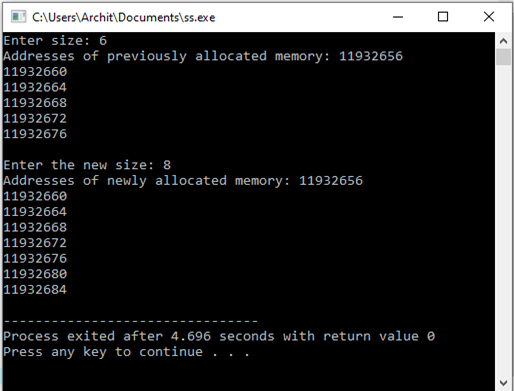
Free Vs Delete In C
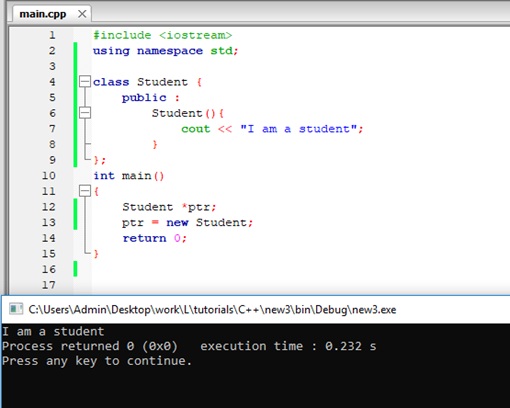
What Is The Difference Between New And Delete Operator In C Pediaa Com
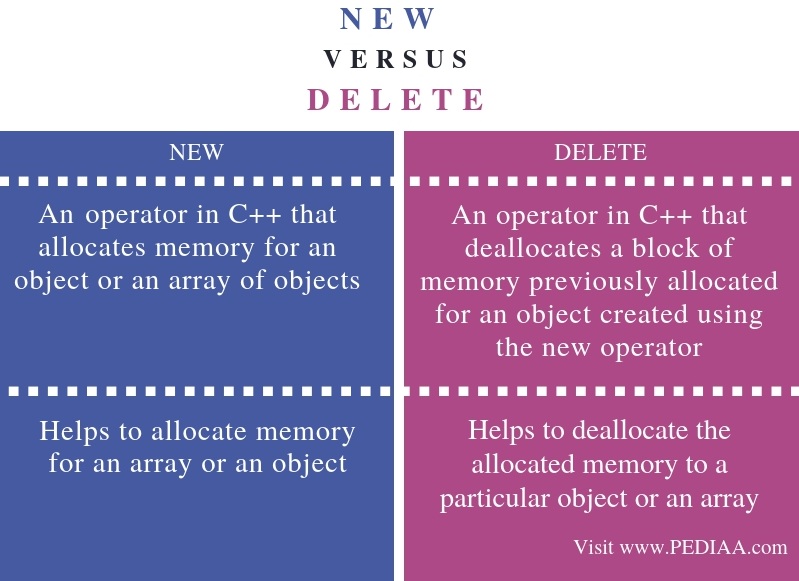
What Is The Difference Between New And Delete Operator In C Pediaa Com

Pointer Variables A Pointer Is A Variable That Contains A Memory Address The Address Is Commonly The Location Of Another Variable In Memory This Pointer Ppt Download
What Is The Difference Between New And Delete Operator In C Pediaa Com
C Review Part 1 Mechanics Part 2 Basics Part 3 References Part 4 Const Part 5 Inheritance Part 6 Libraries Acknowledgement Adapted From Brown Ppt Download

New Delete Operators In C With Examples
Solved 1 Define New And Delete Operator With Proper Chegg Com

C Delete Operator And Destructor What Do They Actually Do And What Are The Differences Of The Two Stack Overflow

C New And Delete Operators Youtube

Introduction To C Lecture No 20

What Is The Difference Between New And Delete Operator In C Pediaa Com

C Overloading The New And Delete Operator Globally Stack Overflow

New Delete Operators In C With Examples
Operator Overloading In C My Blog


Comments
Post a Comment